Rather than replacing clinicians, artificial intelligence is transforming diagnostic workflows across India by offering unprecedented strength in pattern recognition and augmenting human decision-making.
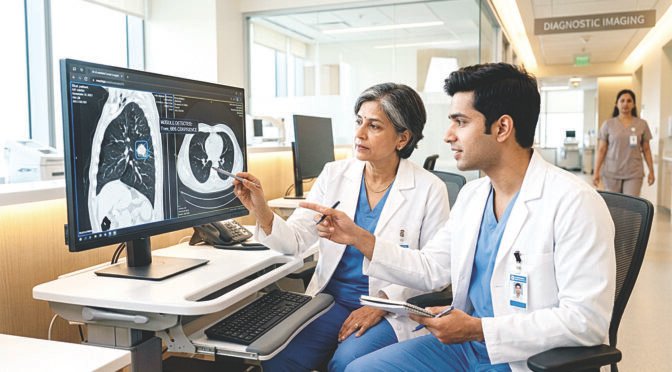
Today, if you walk into a diagnostic centre in Delhi NCR, there is a high probability that AI is involved somewhere in the process—perhaps flagging a suspicious area on a chest X-ray, reading a retinal scan, or helping to decide which report a radiologist should prioritise for review. The dramatic headlines suggesting that AI is taking the place of a doctor are not yet a reality. The current integration is more mundane and, in some ways, far more interesting: it functions essentially as a tireless second set of eyes.
At its core, the value proposition of AI in diagnostics boils down to one simple concept: strength. Specifically, it offers strength in pattern recognition at scale. AI tools can be trained on vast datasets of medical images to identify patterns that a clinician in a high-throughput, fast-paced clinical setting—such as a radiologist examining dozens of scans during a single shift—might miss. This does not necessarily mean the technology sees things that a trained human expert cannot; it simply does not suffer from fatigue.
We have already begun to see this technology put to visible use in specific areas of diagnostic work:
- Diabetic Retinopathy Screening: An area where AI reads eye scans for early signs of diabetic vision loss. These technologies are increasingly deployed for population screening, given India’s massive diabetic population and a disproportionate scarcity of ophthalmologists.
- Radiology: Certain AI tools are being developed to assist clinicians in reading X-rays and scans by highlighting specific areas of concern for their attention.
Note: These function strictly as support tools, not standalone diagnosticians.
It is worth stating clearly that the tools currently used in diagnostic centres and hospitals are, by and large, not independently making diagnoses or replacing human decision-making; they help humans make faster and better decisions. When an AI tool flags an anomaly on a scan, a qualified physician must still review the entire report and image to make final decisions on diagnosis and treatment. This technology enables a better, more efficient workflow for clinicians and aims to augment their abilities, rather than replace their roles.
Access to and adoption of this technology will undoubtedly vary across the country, and even across facilities within a single city. For example, larger hospitals and diagnostic chains are more likely to adopt these technologies than small, standalone clinics.
Overall, however, this evolution is not about replacing doctors with AI, but about altering how they work—providing an additional layer of intelligence in a highly complex field rather than a shortcut to skip a crucial step. Furthermore, this integration has yet to be consistently proven on a scale across the healthcare system to bring about a significant change in outcomes.