Smartwatches have quietly evolved into genuine health tools. Here’s what they can actually detect, and what they can’t
Smartwatches have quietly evolved from glorified pedometers into genuine health-monitoring tools. Here’s what they can reliably flag—and what they can’t.
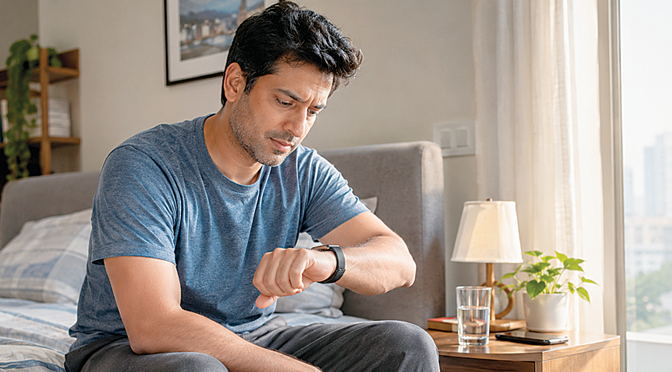
For much of the last decade, the smartwatch on your wrist was simply counting your steps and nagging you to get off your butt. Not anymore. Today’s wrist-worn gadgets are equipped with sensors that measure heart rhythm, blood oxygen, skin temperature and sleep patterns with an accuracy that, only a few years ago, would have been limited to hospital-grade machinery.
What’s now less an issue of whether these capabilities exist—which they do on most flagship watches—is how reliable they are.
Heart-rate monitoring is perhaps the most established and reasonably reliable use case for this kind of technology. But it is only the tip of the iceberg. Several smartwatches now offer ECG monitoring capable of detecting atrial fibrillation, an irregular heartbeat that could otherwise go unnoticed for years. This isn’t a replacement for a medical ECG, but rather a flagging mechanism that can encourage a visit to the doctor. The feature is especially relevant to asymptomatic individuals who wouldn’t otherwise have any reason to undergo cardiac rhythm monitoring.
Blood oxygen saturation has also become a common addition to smartwatches, gaining particular prominence as a pandemic-era safety tool. While it can provide a useful general reading, its accuracy is not as good as one might think. Factors such as skin tone, movement and how tightly the device fits can affect the reading. A consistently low reading can be a useful indicator that you should seek medical attention, but it is certainly not a definitive diagnostic tool.
Gone are the days of simply noting how many hours you slept. Many wearables now estimate sleep stages and, more helpfully, can alert you to patterns characteristic of disordered breathing during sleep, such as sleep apnea. This can genuinely be helpful as a starting point. Sleep apnea is significantly underdiagnosed, and people experiencing it often don’t know they have it.
You still require a definitive sleep study, of course, but a watch’s ability to flag a pattern—for example, disrupted breathing during sleep—might be what prompts someone to get tested.
Skin-temperature sensors, which seem to be appearing in more devices over the past couple of years, can detect relatively small fluctuations that might precede a cold or, on some devices, help estimate fertility windows. For the most part, these are more interesting as trend data points than as measurements that mean much on any single day.
Those limitations matter, though. Wrist-worn devices are tools for screening and raising concern; they are not diagnostic devices, and they can produce false positives. Indeed, when it comes to health monitoring, it is arguable whether a false positive or a false sense of reassurance may have the greater negative health impact. A healthy heart rate or perfectly smooth sleep doesn’t prove that a person is free from health problems. It’s quite possible to have a heart problem that the watch simply isn’t designed to detect.
So, in many ways, a smart device acts more as an early-warning system than as a doctor. At the end of the day, a smartwatch is only as useful as what you do after you receive its alert.
Blurb 1 — Recommended
Today’s smartwatches can track far more than steps. From heart rhythm and blood oxygen to sleep and skin temperature, here’s what those health alerts can—and can’t—tell you.
Blurb 2
A smartwatch can flag an irregular heartbeat or suggest a possible sleep problem, but an alert is a reason to investigate, not a diagnosis.
Blurb 3
Wearables are becoming useful early-warning systems for health concerns. But their greatest value may depend less on the alert itself and more on what you do next.