
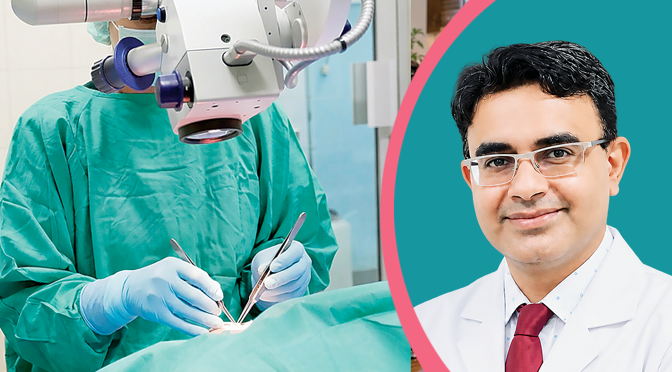
In this exclusive conversation with Know Your Doctor Magazine, Dr. Saurabh K Gupta, Plastic & Reconstructive Surgeon, talks about the real breadth of the specialty—from road-accident trauma and microsurgery to reconstructive procedures and cosmetic trends that warrant caution
Most people equate plastic surgery with cosmetic procedures. Can you walk us through the actual breadth of what your department handles in a typical week?
Plastic surgery is often thought of as being only about cosmetic surgery. Most people in India think that way, as if this is all a plastic surgeon can do. But that’s not true; we do much more than that. In plastic surgery, we do a lot of trauma surgery, onco-reconstructive surgery, microvascular surgery, and cosmetic surgery is just about 20 per cent of what we do. So, we are involved in major surgeries, not just cosmetic procedures.
What is the single biggest misconception patients, or even other doctors, have about what a plastic surgeon actually does?
The misconception is that it’s all about cosmetic surgery—breast reduction, eyelid surgery, eyebrow lifts, facelifts, liposuction and so on. But this is only a very small spectrum of all the surgeries we do.
We handle massive crush injuries and trauma, including road-traffic accidents, where very complex surgeries are needed and where orthopaedic or general surgeons alone may not be able to manage the case. In these more specialised cases, plastic surgeons are called in and we perform the surgery.
Especially in oncology, when a part affected by cancer is removed, plastic surgeons come in to reconstruct it. For instance, if a jaw is removed because of cancer, we can take a fibula flap from the leg to reconstruct the lost part of the mandible, and then anastomose smaller vessels in the neck.
So, these are the kinds of surgeries we actually perform as plastic and reconstructive surgeons.
Road-traffic accidents are common in Delhi-NCR. When does a plastic surgeon get involved in trauma cases, particularly with severe soft-tissue loss or degloving injuries?
Road-traffic accidents are definitely very common in Delhi-NCR. We have to deal with very severe trauma cases because there are so many vehicles and people sometimes drive recklessly without following traffic rules.
We very often perform trauma surgeries. We handle massive crush injuries and restore function. In some cases, there is soft-tissue loss or degloving injuries, so we restore those areas, reconstruct using whatever tissue remains, or bring skin from elsewhere in the body and use flaps and grafts.
Can you explain what microsurgery involves, and why it’s considered one of the most technically demanding and delicate areas of plastic surgery?
Yes, definitely. Microsurgery involves operating under a microscope. What happens is that you take tissue from one place and transfer it to another part of the body, freeing it from its original site.
For example, suppose I need to perform a mandible reconstruction after cancer surgery, and there isn’t sufficient tissue around that area to proceed with the reconstruction. In such cases, we take a bone flap along with its blood supply, bring that blood supply up, and anastomose it with the vessels in the neck. The blood supply is then restored in the new location. This is what we call microsurgery.
It’s very technically demanding because hand-eye coordination is extremely important, and it is entirely hands-on work. You’re preparing an artery under a microscope and placing sutures that can be just 1–2 mm, which makes it a demanding and challenging branch of plastic surgery.
What’s a myth about burn first aid that you wish people would stop believing? And what’s the one mistake you see people make repeatedly after a burn?
Another key topic I’d like to discuss is burn injury. We’ve seen that, generally, patients panic in burn cases. Someone applies toothpaste, someone applies ice water, someone applies something else, and they forget the basic principles.
I want to make this clear: in case of a burn, do not panic. Cool the affected area under running water. The mistake people make is applying ice directly. If hot liquid has spilled on the body, ice should not be applied because the skin has already been exposed to heat, and applying ice directly can cause further tissue injury through an extreme temperature change.
Do not go to such extremes in temperature; simply place the affected area under running water.
If someone accidentally cuts off a finger, what actually happens next? Can it always be reattached, how much time do surgeons realistically have, and how successful are these attempts?
Definitely, we see a lot of cases where fingers are detached, either from agricultural accidents in villages or from machinery accidents, which are quite common.
If someone’s finger is accidentally chopped off, the first step is to take the detached part, wrap it in a gauze piece, place it in a polythene bag, and put that inside an ice box. The most important thing is that it should not be in direct contact with ice or placed directly in water.
It should be kept in a box and transferred to the nearest facility where microsurgery is available. Six hours is generally considered the golden period. Within six hours, it can potentially be reattached through microsurgery, and if done properly, the success rate can be quite good. The bone is fixed and the vessels are anastomosed through microsurgery under magnification.
What role does plastic surgery play after cancer surgery, particularly breast reconstruction after a mastectomy? How has reconstructive surgery evolved in India in recent years?
Plastic surgery plays a very important role nowadays. When cancer is removed, a defect is left behind, and a plastic surgeon is called to address it.
In cases such as breast cancer, a mastectomy can mean losing a breast, which can cause significant emotional distress. We can reconstruct it using tissue from the patient’s own body. For example, there is a latissimus dorsi muscle at the back, which can be brought to the front to reconstruct the breast. Alternatively, if the patient is willing, an implant can be placed beneath the skin flap.
So, the loss of the breast can be restored, which can also help the patient emotionally after reconstruction.
Reconstructive surgery has definitely evolved in recent years. With the development and advances in microsurgery, reconstruction has become more sophisticated and sustainable. We’re now seeing microsurgeries and even super-microsurgeries being performed. In these cases, tissue can be taken from one part of the body and reattached elsewhere.
That’s the beauty of microsurgery. With the development of these procedures, it is now possible to perform cases that might not have been considered possible earlier.
Since cosmetic surgery is also part of your practice, what would you say is the most over-requested procedure, and what’s one procedure that’s actually far more helpful than people realise?
Yes, cosmetic surgery is very much an integral part of our practice. The most over-requested procedure is liposuction; we get three to four queries for liposuction in a week.
Liposuction involves removing fat using a small cannula through a small opening. It can help create better body contouring. For some people, the procedure can also provide motivation to continue making lifestyle changes. Once they have achieved a certain body shape, they may want to maintain it, and that motivation should continue along with proper exercise to sustain the results.
With cosmetic procedures and beauty trends going viral on social media, is there a trend that particularly concerns you from a medical safety standpoint?
Definitely. As cosmetic procedures and beauty trends go viral on social media, one of the most concerning issues is the number of unqualified or inadequately trained people offering cosmetic procedures in salons or cosmetic wellness centres.
They may offer procedures at attractive prices or make misleading claims, and people can fall prey to them. I would like to emphasise that people should check a doctor’s degrees and qualifications before undergoing any procedure. We have heard of cases where even minor cosmetic procedures have resulted in serious, life-threatening complications.
So, it is very important that you choose your doctor wisely. The doctor should be properly qualified and trained in plastic surgery and should have genuine experience performing the procedure.
What’s happening in plastic and reconstructive surgery right now—a new technique, technology or approach—that you’re personally most excited about as a doctor?
As we see growing trends and advancements in plastic surgery, many new technologies are emerging. AI-based tools, for example, can give patients an idea of how they might look after surgery, such as after rhinoplasty and similar procedures.
I’d also like to emphasise that endoscopic surgeries are becoming more prominent. One example is the endoscopic brow lift. There is no large incision; instead, small openings are made, an endoscope is inserted and the eyebrows are lifted.
These techniques are increasingly coming into the limelight, with more people showing interest and more inquiries coming in for endoscopic and minimally invasive procedures.
Dr. Saurabh K Gupta is the Director and Head, Dept. of Plastic, Aesthetic & Reconstructive Microsurgery at Yatharth Group of Superspeciality Hospitals, Noida , Greater Noida & Elixir Health care, Noida. He can be reached at 9868379663.