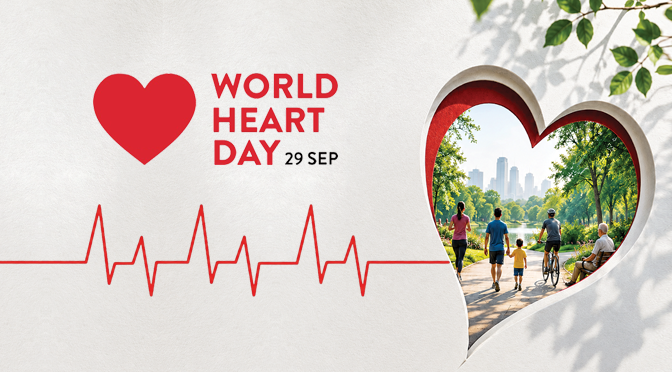
September 29 marks World Heart Day—a global reminder that the hardest-working muscle in your body has been quietly clocking in every second since before you were born and has never once asked for a break
Do the maths. Your heart beats an estimated 100,000 times a day. Over an average lifetime, that adds up to more than 2.5 billion beats.
No coffee breaks. No holidays. No time off.
That little pump in your chest has been working without pause since before your first breath and will continue to do so for the rest of your life. Yet it is probably one of the organs we think about the least—until it makes it clear that we can no longer afford to ignore it.
That is the ironic truth that September 29, World Heart Day, hopes to address. Created by the World Heart Federation, the day draws attention to a powerful reality: cardiovascular disease remains one of the leading causes of death globally, and a significant proportion of cardiovascular risk can be addressed through prevention and timely action.
The message is simple: not everything can be prevented, but much can be avoided.
The Heart Doesn’t Send Memos
The core problem World Heart Day is trying to address is this: the heart often communicates very poorly.
Blood pressure can rise steadily for years without producing a symptom. Cholesterol levels can increase without making a person feel noticeably different. The body can begin developing insulin resistance long before anything feels wrong.
And then, one day, symptoms appear.
By then, the message may no longer be a gentle tap on the shoulder.
That is why routine health checks matter. When did you last check your blood pressure? Do you know your cholesterol levels? Have you asked enough about your family’s history of cardiovascular disease?
These are not necessarily dramatic or frightening questions, but they can be important ones. Yet it is remarkably easy to put them off unless something reminds us to stop and ask.
Perhaps once a year is enough to provide that reminder.
Not Just Your Grandfather’s Disease Anymore
For years, the image of heart disease was fairly static: an older man who had gained some weight, smoked and carried a few decades of high stress behind him.
That image has not aged well.
Concerns about heart health are increasingly entering the lives of people in their 20s and 30s—not necessarily because of one dramatic risk factor, but because of the slow and relentless toll of modern urban life.
Long periods spent sitting. Constant low-level stress. Irregular sleep. Highly processed and convenient foods.
Individually, these habits may not appear particularly alarming. But over time, their cumulative effect can matter.
The themes of World Heart Day vary from year to year. One year may emphasise equal access to care; another may focus on diet, movement or the often underappreciated connection between mental wellbeing and physical heart health.
But beneath these changing themes is one consistent message: the conversation about heart health has expanded.
It now needs to begin earlier.
Heart health is no longer simply a conversation about a “future you”.
The Boring Advice That Actually Works
If World Heart Day could be summed up in a tagline, it probably would not go viral.
Move your body reasonably and regularly. Ease off highly processed foods, added sugar and excessive salt. Quit tobacco, whatever form it comes in. Keep alcohol consumption within sensible limits. Sleep well—it is, after all, one of the pillars of good health alongside diet and exercise, yet often the first thing to be sacrificed.
And get your routine checks done. Blood sugar. Blood pressure. Cholesterol.
The aim is to act preventively rather than reactively.
None of this is rocket science. Almost everyone reading this probably understands the essence of it somewhere.
The problem is rarely a complete lack of knowledge.
It is the follow-through.
That is the gap World Heart Day hopes to address—not necessarily by offering dramatic new information, but by providing a gentle, non-judgemental reminder to act on what most of us already know.
One Date, A Much Longer Relationship
September 29 need not simply be another date on a calendar or an item on a to-do list.
Perhaps it can be an annual appointment—an informal check-in with an internal organ that ordinarily never asks for one.
After all, it is a relationship that should outlast almost every other relationship in your life.
The point is not to change your entire lifestyle overnight.
It is something less dramatic and perhaps more honest: to take a moment and ask whether your daily choices are serving this one muscle as well as it has served you, consistently, throughout your entire existence.
And perhaps, if you have been putting it off for a while, now is the time to make that appointment