
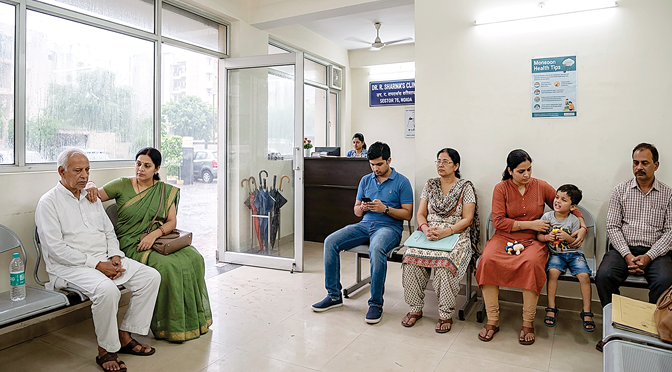
Spend an hour in a local clinic’s waiting room, and a neighbourhood quietly reveals itself. A ground-level look at who’s there, and why
A peculiar form of anthropology happens within a clinic’s waiting room; it has less to do with medicine and more to do with the people occupying the space. Spend just an hour inside a clinic anywhere in the NCR on any given day, and a community will emerge in front of your very eyes, not through direct exchange in words (that’s generally rare), but through a simple arithmetic of presence: who is there, what they bring with them, and how they wait.
Let’s take an afternoon in an old, dense neighbourhood—a clinic in a cramped housing society somewhere in Noida or Ghaziabad, for instance. The room gets populated erratically through the day, yet its composition follows certain repeating routines, almost like a slapstick.
In the morning, the elderly tend to dominate the queue. They usually come in early, frequently accompanied by a family member, and take their time getting to a seat. Doctors say this trend is predictable; older residents prefer to tick off health checks before the sun gets too high and the crowd becomes unbearable, and their presence often means a family member has to reorganise their morning schedule. Watch how one hand holds another and how the file passes from one family member to the next—these simple arrangements of mutual dependence and care happen long before a patient gets to see the doctor.
Mid-morning presents a whole different kind of clientele. Now the professionals start showing up, people whose bosses have apparently granted them a lunch break so they can pop in to see the doctor, still not entirely put-together in business-casual wear, with the smartphone that has become an extension of their body in hand and one eye furtively on the clock, as if rescheduling a meeting in their head.
These patients fall into typical modes as well: patients with sore throats, patients who have been “monitoring” their mild fevers for two days straight, and visible cases of the kind of all-over fatigue people develop from going through the motions during Zoom calls.
There’s a silent understanding among this group, an unwritten alliance of suffering. Those of us sharing these particular three chairs are united by a shared reluctance to admit that whatever bothers us has officially won its fight against our better judgement and/or career ambition since Monday.
The afternoons witness yet another distinct population: kids.
This means an even greater amount of buzzing around; the same fidgeting of hands and tapping of feet that you get during an all-hands business presentation, just with parents now wielding the distraction of a smartphone to keep a feverish little body still, even for the 20 minutes before their child’s name is called.
And while the diagnosis of these children might, doctors explain, often be a fairly mild viral infection, an upset stomach or even pink eye spread through a school class, the parents typically seem a little more flustered. They exhibit that unique dread of the parent who desperately wishes they could just take all their child’s symptoms onto themselves—the worry less about the ailment and more about the inability to truly spare their offspring from even mild discomfort.
It’s also what the composition of the waiting room tells you about the neighbourhood.
Something local doctors have quietly picked up on over the years of practice, without thinking to categorise it in any formal way: a clinic in a residential society with a considerable population of elderly people will not have the same waiting room as one located next to a bustling commercial hub, with rows of young working men and women on its doorstep.
There will always be an increase in patients clustered together in the aftermath of an outbreak of conjunctivitis or a stomach upset in a single classroom, once the illness makes its rounds from one child to the next. A few days later, four or five of them from the same school, even the same section, may make it to the doctor’s clinic, again on the same couple of days.
It becomes a quiet, informal way of observing how a virus, say, moves through a community—from classroom to classroom, from home to home—long before it makes its mark on official health records.
Even the act of waiting has a tale to tell.
Doctors observe that in areas where a clinic’s presence is an exception rather than the rule, where clinics are few and far between, the waiting room naturally fills up, the wait gets longer and patience gets shorter. Once you’ve had to come this far, it’s unlikely that you’ll stand there calmly.
A clinic in an area that is better served, with multiple clinics in the vicinity, would not have the same sense of an impending wait; appointments would be spread out more evenly. The waiting room would feel less like an endurance trial and more like an errand.
What, in short, connects all these points, according to doctors, is that a waiting room is actually a live, unfiltered snapshot of the health pattern of a neighbourhood—not a curated view presented to us in surveys and official documents, but the actual reality: who is getting sick, at what frequency, how far people are prepared to travel before giving up and opting for a clinic, and how long they will finally consent to wait in that clinic.
It’s nothing anyone seeks to investigate; it’s just what happens when one room fills up, week in, week out, with more or less the same sort of people and the same sorts of diseases, standing inches away from one another, mostly in silence. Each is a small data point, an interesting pattern the clinic staff has inadvertently grown used to reading.
By evening, the room empties out the way it filled: gradually, unevenly, one name called after another, until the chairs are empty and the fans keep running for nobody in particular.
Tomorrow, the same neighbourhood will walk back in, in roughly the same order, carrying roughly the same set of complaints.
And the waiting room will, once again, quietly tell on all of us.
BLURB
“A clinic’s waiting room is actually a live, unfiltered snapshot of the health pattern of a neighbourhood.”
“Each is a small data point, an interesting pattern the clinic staff has inadvertently grown used to reading.”
“The waiting room will, once again, quietly tell on all of us.”