
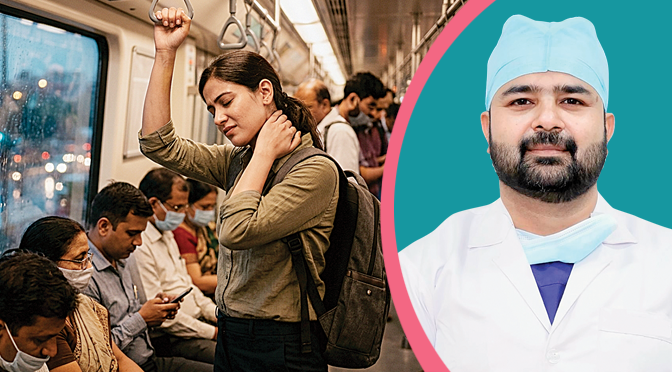
From corporate desk culture and poor gym habits to cutting-edge robotic surgeries and stem cell research, a leading specialist shares key insights into the rising tide of joint problems among young adults—and how to protect mobility across every stage of life.
As modern lifestyles increasingly take a toll on joint health, musculoskeletal problems are no longer confined to older adults. In this exclusive conversation with Know Your Doctor Magazine, Dr. Rahul Kumar, Orthopedic Surgeon, shares his expert insights on why joint pain is rising among younger people, the impact of sedentary habits and fitness trends, advances in orthopedic treatments, and practical advice for maintaining healthy, pain-free joints at every stage of life.
Joint pain used to be seen as an “old age problem.” Why are you now seeing it in patients in their 20s and 30s?
It is a striking trend these days. While joint issues were once considered a hallmark of old age, they are now common in younger adults due to a perfect storm of modern lifestyle factors and corporate work culture. People sit in front of screens for 10 to 12 hours daily, which primarily affects the cervical and lumbar spines. Over time, their muscles weaken, which impacts their joints in the long run.
A lack of physical activity is another major factor; it leads to increased body weight and muscle weakness, accelerating cartilage wear and tear and causing early osteoarthritis, especially in the knee and hip joints. A few other reasons include poor nutrition, working out without proper knowledge of posture, and children increasingly specialising in a single sport year-round at a young age. Instead of playing a variety of sports that develop all-round athleticism and balanced muscle groups, they repetitively stress the same joints and growth plates. This leads to overuse injuries in the elbow and shoulder joints.
What’s really driving the rise in knee and back pain among young professionals — desk jobs, screen time, or something else?
Desk jobs are a major contributor to back and knee problems. Sitting at a desk for long hours in front of a screen leads to muscle weakness, poor posture, and strain on the spine. Initially, this manifests as a mechanical backache, but if it continues for a long time, it can lead to disc prolapse, nerve compression, and listhesis of the spine.
The same issue applies to people using phones, tablets, and laptops for long hours while lying on a sofa or bed. Young professionals are so busy with their jobs and careers that they neglect their health, leading a sedentary lifestyle that directly impacts their joints. Furthermore, some individuals only go to the gym on weekends and work out with heavy weights without proper guidance, which further damages their spine and joints.
More young people are hitting the gym today. Is that helping joint health, or causing more injuries?
People going to the gym is not an issue in itself. However, before starting to exercise and lift weights, individuals should possess a basic knowledge of proper posture and muscle anatomy, and consult a doctor if they have any chronic illnesses. It is always better to seek guidance from experts, such as certified trainers, taking a slow and steady approach. Consistency is key. Most injuries happen during weightlifting when posture is incorrect or when lifting heavy weights simply to satisfy one’s ego. Always use a belt, wristbands or supports, and knee bands when lifting heavy weights.
What early signs of joint strain do young people usually ignore?
1. Warm-up pain: A dull pain and stiffness in the knee, hip, or shoulder present during the first 5–10 minutes of a run, workout, or even just walking downstairs in the morning. Because it subsides after a short while, many people ignore it. However, it is a classic hallmark of mild tendon inflammation or early-stage cartilage softening (chondromalacia).
2. Post-activity stiffness: People often ignore this sign, assuming, “I must have overdone it” or “I just sat down for too long.” Delayed stiffness indicates a low-grade inflammatory response.
3. Compensatory clicks, clunks, and shifts: A deep clunk is often a sign of joint instability or a torn labrum (in the hip or shoulder), while a painful pop in the knee can be the IT (iliotibial) band snapping over the bone, causing friction.
4. Loss of passive range of motion: A painless loss of motion is often the very first physical sign of a joint problem. The body quietly stiffens the joint capsule to protect it, and you will not notice until the loss of motion starts impacting functional everyday movements.
When does normal joint stiffness become something that needs medical attention?
1. Morning stiffness lasting more than 45–60 minutes: Stiffness every morning that gradually eases with movement is a classic hallmark of inflammatory arthritis, such as rheumatoid arthritis. Waiting months to address this type of stiffness can lead to irreversible joint damage.
2. Night-time discomfort: Pain and stiffness that wake you up at night and disturb your sleep, especially if you have to get up and walk around to relieve it.
3. Stiffness with systemic symptoms: Stiffness accompanied by unexplained weight loss, loss of appetite, low-grade fever, or night sweats, which may be due to an infection like joint tuberculosis.
4. Severe local inflammation: Redness, heat, and gross swelling of a joint alongside stiffness are signs of septic arthritis. This is an orthopaedic emergency, and the person should immediately go to a hospital.
5. Mechanical symptoms: Joint stiffness accompanied by a locking or “giving way” sensation suggests a mechanical issue, such as a torn meniscus or a loose body in the joint. This requires medical attention even if the pain is not severe.
Is joint pain more genetic, or more lifestyle-driven?
There are many conditions that have a genetic predisposition and affect the joints, such as rheumatoid arthritis, ankylosing spondylitis, and psoriatic arthritis. Lifestyle also plays a significant role in joint health. However, stating whether joint pain is predominantly genetic or lifestyle-driven is difficult to determine definitively, as both factors are closely linked.
Are there Delhi NCR-specific habits — commutes, desk jobs — fuelling joint issues here?
Yes, there are very specific habits and environmental factors in Delhi-NCR that are directly fuelling joint issues, often in ways people do not connect. Prolonged, static sitting in traffic gridlock for 1–2 hours means the spine is held in a constant state of vibration and micro-trauma without the muscle activation needed to pump out inflammatory waste products. This starves the intervertebral discs, which lack a direct blood supply. For anyone driving a manual car, the constant, repetitive motion of pressing a heavy clutch through kilometre-long jams creates an overuse injury of the hip flexors and lateral torque on the knee of the braking leg. This is a direct cause of hip bursitis and patellofemoral pain syndrome (pain around the kneecap).
Desk jobs are also affecting joints. Sitting for prolonged hours at work, combined with using Western toilets, means spending the day in 90-degree hip flexion. This leads to chronically shortened, tight hip flexors that pull the pelvis into an anterior tilt, straining the lumbar spine every time you stand up. Furthermore, the standard office setup with a laptop directly on the desk is a recipe for creating “forward head posture”. For every inch the head moves forward, the load on the upper spine and neck increases by an extra 4–5 kg.
Finally, air pollution causes PM2.5 particles to enter the bloodstream, triggering a low-grade systemic inflammatory response with elevated cytokines (such as IL-6 and TNF-alpha). This creates an environment that can exacerbate existing rheumatoid arthritis or even accelerate the inflammatory component of osteoarthritis.
How has joint replacement treatment changed in recent years? Are patients delaying surgery more now?
Joint replacement treatment has advanced considerably in recent years, with the focus shifting dramatically towards personalisation, faster recovery, and precision. Advances in pain control and surgical techniques mean many patients now go home on the same day instead of staying in the hospital for days.
Robotic and AI-guided precision represents a major leap beyond traditional surgery. Robotic systems like Mako and Rosa do not operate independently; they are tools that provide the surgeon with a real-time 3D map of the joint. These systems help the surgeon stay within a pre-planned boundary with sub-millimetre accuracy, protecting vital soft tissue and helping to balance ligaments perfectly. For complex cases, patient-specific implants are 3D-printed from titanium powder to match a person’s exact anatomy.
Regarding timing, patients almost always try conservative treatments first—such as medication, physiotherapy, and joint injections like steroids, PRP (platelet-rich plasma), or viscosupplements. Only when all conservative treatments fail to provide relief do they proceed with joint replacement.
What’s your advice for elderly patients who want to stay mobile without overexerting their joints?
For active elderly patients, I recommend morning and evening walks, yoga, and exercises aimed at strengthening the muscles around the joints. In particular, I highly recommend cycling, which is one of the best exercises for the lower-limb joints. As a non-weight-bearing exercise, it maintains muscle strength in both legs while keeping the joints mobile. However, once a person develops osteoarthritis, they should avoid squatting, sitting cross-legged, climbing stairs as a form of exercise, and using Indian-style toilets.
Are treatments like PRP or physiotherapy genuinely changing outcomes today?
Yes. PRP (platelet-rich plasma) helps patients with osteoarthritis by releasing growth factors that aim to reduce inflammation inside the joint, promote tissue repair, and support cartilage regeneration. Physiotherapy aims at strengthening muscles around the joints, increasing range of motion, and utilising various modalities like TENS (transcutaneous electrical nerve stimulation), ultrasound, and LASER therapy to relieve joint pain.
What’s a joint pain myth you keep having to correct, across all ages?
The belief that if your joint hurts, you should simply rest it. While rest is wise for the first 24–48 hours following an acute sports injury, prolonged rest for chronic osteoarthritis leads to muscle weakness and joint stiffness, ultimately worsening the pain cycle.
Would your advice differ for a 25-year-old, a 45-year-old, and a 65-year-old — or is it the same?
Yes, my advice differs for each age group. It depends entirely on an individual’s current joint and muscle condition, as well as their overall health.
What joint symptom should nobody ever ignore or self-treat?
If a patient experiences severe pain, joint instability, or locking of the joint, they should never ignore or self-treat these symptoms.
What’s one piece of viral fitness/joint advice you wish people would stop following?
Copying an elite athlete on social media and attempting to train like them is a fast track to injury and burnout. Their training programme is designed for a full-time athletic schedule, tailored to their genetic gifts and recovery resources—not a standard 9-to-5 lifestyle.
What development in orthopedic care are you most excited about right now?
I am particularly excited about ongoing research into stem cell therapies like BMAC (bone marrow aspirate concentrate). In this regenerative treatment, a patient’s own concentrated bone marrow cells, growth factors, and stem cells are used to reduce joint pain, calm inflammation, and support tissue repair in damaged tendons or joints.
Dr. Rahul Kumar is the H.O.D, Orthopedics at MASSH-Manas Hospital, Noida. He can be reached at 8800886578